Showing posts with label CBS. Show all posts

07 February 2024

The Disney-Fox-Warner Bros. Streaming Service Is Just Fubo-Lite - An Analysis

The streaming sports joint venture of Disney, Fox, and Warner Bros. Discovery is a lot less revolutionary than the popular press seems to think. It does sound like something the sports fan might be requesting -- nearly all of the sports on cable, without the non-sports to clutter (and push up the price of) the package.

Disney brings to the table ESPN and a number of other full-time sports services and ABC. Fox has the Fox broadcast network and Fox Sports 1 (among others). Warner Bros. Discovery brings the general entertainment channels TNT, TBS, and truTV which each carry some sports (truTV only has a sliver of sports -- a few games during March Madness).

Unlike Netflix or Amazon Prime, this service will not just carry the games, but will also carry all the other stuff on the included channels. So, the experience of watching the NBA on TNT (supplied by WBD) in this service will be the same as watching it on cable. When the game ends, NCIS or Charmed or another entertainment program will follow it.

The as-yet-unnamed service will be carrying linear channels, much like any other virtual multichannel video programming distributor or MVPD (e.g., YouTube TV, Hulu with Live Channels, Sling). Calling it a "streaming service" is a bit of a misnomer, since that term usually describes a mostly on-demand assortment of programs with a sprinkling of live sports.

In essence, what this new service will provide is a sports-oriented skinny bundle, which is essentially the part of the market that fuboTV has staked out. The issue for fubo was (and is) that the sellers of the channels with live sports were generally unwilling to sell the sports channels at the time that fubo launched in January 2015 without fubo also taking their non-sports channels. For example, Disney would really prefer a distributor to carry the Disney Channel and FX in addition to its suite of ESPN sports services (e.g., ESPN, ESPN2, ESPNews, Longhorn Network). It might not be that Disney would not sell the sports services separately, so much as Disney would make the deal terms far less attractive if the non-sports channels were excluded. So fubo's attempt to super serve sports fans ended up being mostly a replication of the full channel lineup carried by the leading MPVDs, with only a few exclusions (channels from cable programmers without any sports programming like AMC, A&E, and Hallmark).

Among the three partners, nine years later, they were willing to sacrifice the non-sports services, provided that the other guys did, too. Because the new service is carrying linear channels, there is no new grant of rights needed from the suppliers of the programming -- the sports leagues. To them, this is a new MVPD.

It is unclear to me if there is much of a market for this service. If it were significantly less expensive than the full cable package, there may very well be. However, each of these programmers is likely selling their channels to the new service at full rate card. The technical costs of streaming the channels to customers costs money as does customer service and processing credit cards. It is unclear if this package can be sustainably much cheaper than cable or a vMVPD. 

What is clear is that the package will be without a bunch of high profile sports -- notably those controlled by NBC and CBS and smaller sports services like Tennis Channel -- and that lacking those and the cable entertainment and news channels, the package might be less-than-satisfactory in meeting the needs of families, where a package that has sports and also has Nickelodeon, Fox News and Lifetime might seem like a better deal, even if it costs a bit more. 

Another ramification is that all of the MVPDs will see this package and ask for similar packaging rights on their systems. The affiliate sales staffs of Disney, Fox and WBD are probably not looking forward to those discussions.

WBD may be the biggest relative winner among the partners, since this new MVPD will fully distribute most of its costly entertainment programming (which runs on the three included channels), while its Cartoon Network and TCM are on the outside looking in. The sports services from Disney and Fox are pure plays; their entertainment services don't have any sports.

Update: fuboTV clearly sees the new venture as a threat, as it felt compelled to issue a press release about it.

Update (16 Feb 2024): The MVPDs' concerns come out in this CNBC story regarding them seeking similar packaging rights for these channels as the the joint venture appears to have.

Update (20 Feb 2024): fuboTV has sued the joint venture claiming antitrust violations related to less attractive licensing terms for the sports channels. fuboTV's press release The US Department of Justice is interested in such an argument, per Bloomberg Law via Reuters. Clarifications to the original post were added and are marked with italics.


23 June 2018

What ESPN+ Says About the Multichannel Future

On April 12, 2018, ESPN launched its thoroughly pre-announced subscription video over-the-top service, ESPN+. The service is notable for ESPN trying to establish a beachhead in the direct-to-consumer video business and not distributing a video service primarily through MVPDs. It is a watershed for the most important programmer in basic cable.


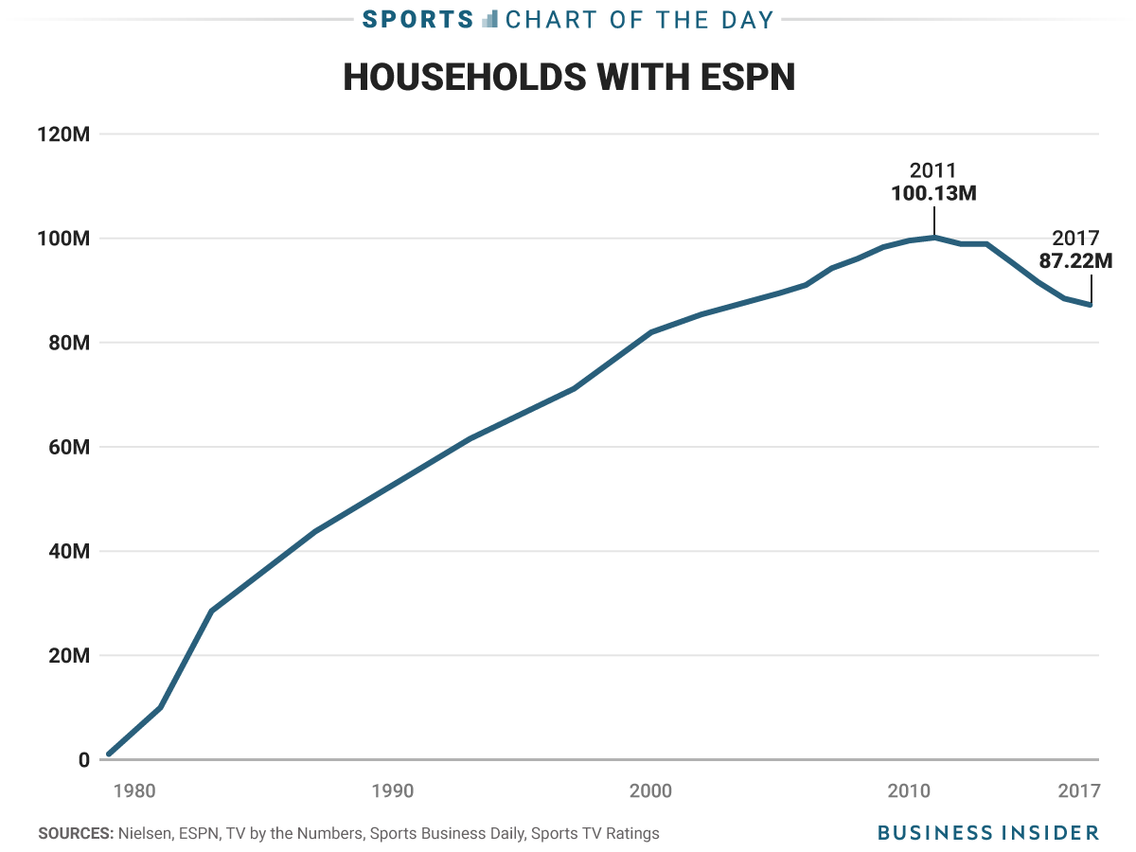
It is not hard to see why. after decades if growth, ESPN has lost household reach for many years from its peak in 2011,


driven by higher basic cable prices and over-the-top video services, led by Netflix, have had tremendous growth during the same period.


To remain "The Worldwide Leader in Sports" ESPN has to follow the people.

ESPN has had an over-the-top video service before, ESPN3 provides additional games and other comments to authenticated ESPN subscribers. That service is distributed in coordination with its distributors: facilities-based MVPDs (multichannel video programming distributors - cable, DBS, telco - e.g., DirecTV, Comcast, Verizon FiOS) and, later, virtual MVPDs (e.g., Sling, DirecTV Now).

ESPN had never created a service to address the non-MVPD marketplace. Instead of addressing this growing market directly, they looked to support what the MVPDs were doing to improve the value of the multichannel video subscription as its retail price kept rising. This lead to WatchESPN (its app which distributed its TV Everywhere service ESPN3), ESPN video-on-demand, the short-lived ESPN 3D, etc. That strategy made a lot of sense for a long time.

As the most expensive service by far in basic cable multichannel video, ESPN is the biggest beneficiary of the basic cable TV bundle. The primary benefits of being part of the basic cable package are (1) distribution to consumers and (2) low marketing costs. With the MVPD as the primary marketer of basic cable video subscriptions, ESPN gets a largely free ride. For a cable network, this greatly simplifies the sales process, one needed/needs to get a few dozen key distributors to roll out the network, not millions of individual consumers to buy. Distributors also were keenly focused on selling it. Until the past decade, basic cable was the most compelling offering from cable providers. Now it is not the first priority, eclipsed for cable operators by cable Internet service. [And slightly marginalized by "skinny bundles" of channels that lack ESPN.]

ESPN+ allows ESPN to establish its a direct-to-consumer distribution and is starting from scratch on marketing a video service to consumers. [ESPN does have direct-to-consumer marketing experience with ESPN The Magazine.] There are product, price, promotion, packaging, and distribution issues to sort out. Given its strategic importance, it is not surprising that ESPN decided to go aggressive on price -- at $4.99 per month ESPN+ is materially less expensive than Netflix and Hulu.

The other priority for ESPN is to keep the positive relationships with the MVPDs, because the amount of money coming in via basic cable distribution -- both in affiliate fees and advertising on the TV services -- will likely dwarf the amount of money coming in on ESPN+ for quite a while.

During ESPN's long growth period, adding value for the cable operators was very important. ESPN's affiliate fees, for a long time, increased by an astounding 20% per year. Now, with more typical single-digit rates of increase on affiliate fees, the MVPDs cannot reasonably have the same expectations for added value in ESPN3/WatchESPN.

ESPN has always heavily invested in sports content and then figured out a way to best utilize it to enhance the value of the business. In the 1990s, when ESPN faced little immediate competition on the cable dial and there was no direct-to-consumer Internet video business, ESPN would buy up rights to college football and air few of the games, instead "warehousing" them. The benefit to ESPN was protecting the franchise by not allowing a would-be sports competitor to use this programming to launch or enhance its network. Later, ESPN used additional games to support the TV Everywhere effort -- instead of letting Tennis Channel license extra early round matches of the US Open, ESPN would put them on ESPN3. Now, the best business use of those "extra rights" -- rights not needed to program ESPN, ESPN2, ESPNU, or ESPN's other cable services -- is to build out the appeal of ESPN+.

ESPN going direct-to-consumers is a difficult thing for the MVPD to swallow. MVPDs are used to being the 800 pound gorillas of TV distribution and dictating the key business terms. Historically, the MVPD's only real beef in their dealings with ESPN was its high price -- few questioned its programming or alignment with MVPD objectives. However, all around the multichannel industry, the groundwork has been laid for this moment. Three key over-the-top subscription service launches have led this change.


Starting around 2012, WWE planned to launch a basic cable network, but found little interest from cable operators for more channels for their digital packages. So it launched over-the-top, on February 24, 2017. For WWE, this was, if not a bet-the-company move, something close to it. At first the new network got a tepid response and looked like it might be a disaster -- alienating distributors, like DirecTV, who did not like the impact of this new distribution on their lucrative pay-per-view event busines. Now it is clear that WWE Network was not wrong, and it wasn't even particularly early. The WWE network is clearly an economic success and many of the distributors, like Dish, have found a way to make peace with it.

CBS All Access launched eight months later, on October 28, 2014. Unlike the WWE Network, this was a much less risky endeavor; CBS didn't need the MVPDs in the same way -- its flagship channel's distribution was secure. CBS did need to figure out how to work with its affiliated stations, but both parties had a lot of motivation to sort that out and their interests were basically aligned. All Access turned out to be a brilliant strategic move by CBS to establish its own revenue stream and its own direct-to-consumer distribution. It also works well as a demonstration of the value of the network for retransmission consent negotiations with MVPDs. After all, if consumers are willing to pay $5.99 per month retail for CBS, it is hard for the cable operator to argue that CBS is not worth $1 or $2 or $4 on a wholesale basis. To further support the service, CBS spent money on additional unique promotable content to create some additional reasons for people to subscribe (e.g., its first, The Good Wife spinoff The Good Fight, and Star Trek: Discovery -- both targeted to superfans).

Since CBS All Access is completely under CBS's control, it does not need to work with joint venture partners to make changes to the service or experiment with it, as Hulu does. All Access can be expanded with additional programming and marketing if there is a return; can be scaled back or shut down if it is more profitable to distribute content through MVPDs or other distributors (e.g, Facebook, Apple). It can distribute a version through Amazon with no advertising. All Access is not yet financially material to CBS's business as a whole, but has significant strategic value in establishing a direct-to-consumer business and sorting out the technological, billing, marketing and other issues necessary to run that business should it be the horse that CBS wants to ride over the long haul.


HBO Now was the last big domino to fall when it launched six months after CBS All Access. More like ESPN, HBO's history was synonymous with the growth of early cable. WWE didn't have many direct relationships with MVPDs and CBS, had mostly contentious ones related to retransmission consent pricing. HBO, like ESPN, was a trusted vendor to MVPDs. However, after many fits and starts trying to find a way to launch its service OTT without alienating MVPDs, eventually it just moved ahead, the opportunity was too compelling. And this time, distributors also found a way to make peace with it relatively quickly, which they had to because is has become a material business for HBO it is not going away.

What these three offerings had in common (and how they are all different from ESPN), is that none of them were part of the basic cable bundle. HBO was always available on-top-of basic cable as an a la carte add-on. CBS was always available for free over-the-air. WWE Network was not an established, profitable basic cable channel; it was an aspiring new basic cable channel.

Direct-to-consumer video streaming is the new world, but what does this mean for the basic cable bundle? The conventional wisdom is that sports is the only thing keeping the basic cable bundle afloat, the sports represents unique content that drives all households to subscribe. I'm not sure that is the whole truth.

It has been well documented that core sports fans represent about one-third of cable subscribers, the other two-thirds is casual fans and non-fans. In the UK, where most of the high value sports programming -- Premier League soccer -- is available in a separate subscription, about one-third of customers sign up for it. When NESN, the regional sports network owned by the Boston Red Sox and Boston Bruins, was distributed as an a la carte premium channel, its subscription levels were in the same ballpark (moving up and down with team performance as well).

With the rise of virtual MVPDs, some of the underserved market segments may get services better tailored to their needs. The households with little or no interest in sports are one of them. Historically, there was great fear among distributors in not offering ESPN -- it has been the goose that laid the golden egg. To my knowledge the virtual MVPD Philo TV is the first mainstream service to launch without any major sports. It is a very small player, 50,000 subs at year end 2017 or about 1% of the still modestly-sized virtual MVPD marketplace.

Sports is unique relative to other programming. It is live, unlike most entertainment programs, so it is usually watched live. Unlike the other big category of live programming, news, it is not a commodity -- the audience that watches the NFL does not accept other sports, like soccer or Ivy League football, as a pretty good substitute.

Should MVPDs look on ESPN+ as an existential threat? Will it increase the attrition of basic cable subscribers? From a content perspective, it seems unlikely -- the best sports events are not available on ESPN+ and are only on ESPN and ESPN2. However, if ESPN+ does get established, ESPN will then have another significant outlet and could/likely will, over time, decide to make available some of its programming on ESPN+ in addition to ESPN and ESPN2, later, it might actually take content off the cable channels, in favor of putting it on ESPN+. It is unclear to me if ESPN has already moved content from ESPN3 to ESPN+, but it is clear that it has acquired new content exclusively for ESPN+ like the UFC.

Only a growing market can support additional programming investment. Programming investment is moving off of linear television, which cannot support the cost. The market for basic cable video subscriptions is declining and the market for television advertising is not growing any faster than inflation. We've seen this impact already at ESPN, it is rarely the first choice of TV executives to lay off high profile talent.

Fundamentally, ESPN+ is the hedge to protect Disney for the future in the event that the multichannel bundle declines or collapses. Philosophically, Disney has always been platform agnostic. It has never been allied with an MVPD and would take its high quality content wherever the market led it be that DVD or PPV or something else. Disney sees that it is a strategic priority to develop a direct-to-consumer streaming video platform and is investing heavily to do so. Whether or not it makes a ton of money in the short term does not matter (and it looks like it is not making a ton). That's what a hedge is. Like CBS All Access, ESPN+ is offering more for superfans, but unlike CBS All Access, it isn't offering the the main course. As currently structured, ESPN+ is a complement to getting ESPN in a basic cable subscription, but a poor substitute for it.

My view is that ESPN+ will not be a big success until it is a closer substitute for ESPN and ESPN2 via basic cable.

It is clear that ESPN needs to rationalize its business for the current and future video marketplace. ESPN+ is a shot across the bow of the MVPDs, but the multichannel television business has been under attack for many years now. It would be unreasonable for MVPDs to expect ESPN to go down with the ship. All that said, the ESPN business that comes out of this may not be nearly as profitable a franchise as the one powered by the economics of the basic cable bundle.



13 January 2016

File Under "Duh"

The surprise is not really that Al Jazeera America is shutting down (my link is the Glenn Greenwald's excellent and extensively linked-out article), but that it ever existed in the first place. The multichannel TV dial has a number of fully distributed news services of one flavor or another:
As well as less-than-fully distributed channels like:
An Internet-distributed news channel:
And lots of regional news networks like:


In short, this isn't a market segment with a lack of programming.

It is also hard to imagine that branding the channel "Al Jazeera America" was what US news consumers wanted. Irrespective of the quality of the programming on the channel (which I thought was good, from the little I saw, if somewhat stilted in a PBS/BBC kind of way), the name "Al Jazeera" was most closely associated with the co-owned Arabic-language Al Jazeera news service made famous as the preferred outlet for Osama bin Laden's videos during the post-9/11 era. As the proud possessor of a marketing degree from arguably the finest school for brand managers, I believe that's too much to overcome.


12 November 2013

Over-the-Top Video and The Innovator's Dilemma

Everyone in the ecosystem is wondering about the future of multichannel television and no one knows what to expect. A good theory can help sort out the unknowable. In this post, I will work through what The Innovator's Dilemma theory suggests for over-the-top video and multichannel television incumbents. The fit of theory and subject is pretty good and helpful for seeing the forces shaping offerings into the future.
"Prediction is very hard, especially about the future" - Niels Bohr, Danish physicist
Clayton Christensen's The Innovator's Dilemma is a highly influential book about business markets, particularly what happens when a disruptive new technology appears on the scene.

From Christensen's website:
An innovation that is disruptive allows a whole new population of consumers at the bottom of a market access to a product or service that was historically only accessible to consumers with a lot of money or a lot of skill.
Characteristics of disruptive businesses, at least in their initial stages, can include:  lower gross margins, smaller target markets, and simpler products and services that may not appear as attractive as existing solutions when compared against traditional performance metrics.  Because these lower tiers of the market offer lower gross margins, they are unattractive to other firms moving upward in the market, creating space at the bottom of the market for new disruptive competitors to emerge.
The disruptive innovation definition above is a good fit for over-the-top video, notably YouTube and Netflix, but also Hulu, iTunes, Amazon Prime and Aereo. All these services are, in some form, arguably lower quality and, individually, less expensive relative to multichannel subscription television ("cable TV" for short). If you have cable and try to recreate cable TV by substituting one or several of them, you will probably be disappointed overall. (Many have tried cord-cutting and written about it.)

[The one part of the definition that does not fit is that it is not accurate to say that cable TV "was historically only accessible to consumers with a lot of money." It is clearly a mainstream service by any measure. The service that requires "a lot of skill"? -- that's probably BitTorrent.]

Christensen's theory is that eventually the improvement of the "inferior" new product gets a toehold in a small market that is ignored by the incumbent. Gradually the new product improves, largely through technological advances. Over time that product becomes a better and better substitute for the incumbent product and then, usually all of a sudden, the economics of the incumbent's business are destroyed by the newcomer.

Applying the theory to this case, the toehold market for over-the-top video may be mobile. Selling a separate mobile subscription was basically impossible, as Qualcomm found with its Flo service. However, multichannel television was (and largely is) unavailable on a smartphone and all of the top over-the-top services are easily available on such devices.

How does over-the-top video (OTT) become a bigger threat to the multichannel TV ecosystem:
  1. The technical quality will improve (LTE, 802.11ac wifi, gigabit ethernet to the home)
  2. The quality of the content will improve (YouTube's investments in channels, Netflix and Amazon's investments in original content, continued acquisition of quality library content)
  3. The availability of the service will improve (Aereo's expansion to other markets, more ubiquitous public wifi)
  4. The convenience of the service will improve (e.g., better interface design, more accurate recommendation engines, DVR in the cloud, etc.)
The frightening thing for the incumbents is that none of these developments above require OTT services to do anything other than what they have been doing. Notably, they do not have to take on the risk of making a frontal attack on cable and licensing the popular cable channels.

Even more frightening for incumbents is there is a strong recent history of mobile solutions devouring home-based solutions. More than half of households don't use a landline phone and portable digital audio has done a similar number on home high-fidelity equipment. It is lost on no one in the TV business that this happened without cellphones ever sounding as good as a landline nor an mp3 sounding as good as a CD.

The usual strategy for incumbents, well described in Mark Suster's excellent blog post Understanding How the Innovator's Dilemma Affects You. is that the incumbent provider increases "spending on features / performance / functionality. They gather with their cadre of high-requirement customers and have planning sessions about how they can make even more performant products."

Cutting the price is not an appealing option for the incumbents because they do not want to reduce their profits and cannot cut their prices (and costs) sufficiently to compete with the upstarts. After all, these are big, successful profitable business -- they can't throw that away. So, instead the incumbents respond to the competitive threat by improving the product. 

The problem with the improving-the-product strategy is that it does not work in the long term. As Suster puts it "customer requirements don’t grow exponentially relative to their existing line [i.e., current service]...over time to the new entrant's functional offering [gets closer to the incumbent's] and there is a huge and rapid sucking sound that pulls the bottom out of the market as waves of customers 'trade down.'” In other words, the multichannel distributor can add all the value it wants, but that doesn't mean the consumers will continue to see their expensive package as their best option in the marketplace.

[A multichannel distributor, of course, could always cut its costs by dropping channels, especially expensive ones. However, given the competition between cable, DBS, telco TV and upstarts like Google Fiber -- such a strategy would certainly hurt its attractiveness to the large mass of consumers who want multichannel television. Inviting current customers to shop for a new video provider by dropping their favorite channel might also lead to such customers finding a new broadband provider as well.]

So, that means OTT going to kill cable TV, right?

I don't think that is clear that cable TV is a goner. Unlike phones and stereo equipment, home TV screens have gotten much bigger in the past decade. High definition and DVRs have improved the in-home TV experience. If consumers have spent more on home entertainment gear, it seems somewhat incongruous that they would be willing to forego the premium television content that takes best advantage of it.

The role of content in this marketplace seems like a different factor than anything in Christensen's theory. There is nothing quite analogous (from the consumer's perspective) as a supplier of content for a disc drive or a piece of construction equipment.

OTT providers have some of the content from cable TV -- Aereo provides the live broadcast signals, individual programs are available on Hulu, Amazon, Netflix and iTunes. Live sports is available, via the "season ticket" out-of-market packages from MLB, NBA and NHL, but the more popular local teams and national games are not. There is a lot of original content available on Netflix and YouTube at various levels of quality. It is fair to say that the pay TV ecosystem has locked up the early windows on much of the best content that is available on TV and OTT might not be able to offer a material amount of that for a long time.
Still, as Howard Beale notes in Network, one of my favorite movies, TV is primarily in the boredom killing business, and at some price, not everyone needs a full package of first window premium content to kill their boredom.

What seems more likely than the decimation of the pay TV ecosystem, is its gradual move to become more of a luxury good, rather than a 90%-penetrated household utility. The opportunity for OTT video certainly increases as the spread between the cost of cable TV and the OTT alternatives increases. Netflix streaming (and Aereo and Hulu Plus) has held at $7.99 (each) per month for a while, but that might not hold in the future.

The more interesting question is: how do the programmers respond to the (inevitable) decline in the number of multichannel subscribers?

It seems unlikely that programmers will sell their linear services whole to the OTT providers, since the OTT providers probably don't want them [Aereo is the exception, since it is in the linear streaming business already. It will likely add some basic services to join last-year's addition, Bloomberg, and adding premiums that can be sold a la carte like HBO or Showtime or Starz would appear to be consistent with the Aereo model. It is less clear if those programmers would be willing to sell to Aereo, after all Starz famously stopped selling to Netflix because it was messing up its value proposition for pay TV distributors.]

What's likely is that programmers will sell greater amounts of individual programs to the OTT providers -- that is just a bigger play on something they are doing already. Disney's recent deal to send new, original Marvel programming to Netflix is a great example of this. In the past, Disney would have taken this programming -- which is not needed by its current cable channels -- and created a new cable channel.

Defining programming more narrowly -- around the cable networks' brands -- the picture gets fuzzier. The big distributors are not enthusiastic about paying higher license fees for cable networks, but the greater competition in the distribution market has led them to do so -- they can't afford to be without top channels for too long. While conceding the money, the distributors are looking for added value in those deals (e.g., TV Everywhere rights, expanded VOD rights) and one form of added value are longer windows in which the programming is exclusive to the cable network and does not appear on their websites, Hulu, Netflix, et al. After DirecTV settled its standoff with Viacom in 2012, its chief negotiator said “My expectation is that they will not increase the amount of free programming they have online.” The story after Time Warner Cable and CBS settled was similar -- digital rights was the contentious deal issue.

Since the movement of programming on a show-by-show basis is inherently fluid, the speed at which content goes from the cable TV ecosystem to the OTT ecosystem (and possibly back again, as in the Fox-Comcast library deal) can and will ebb and flow with the prices being offered.

This fluidity might suggest that the fit of The Innovator's Dilemma to the disruptive innovation of over-the-top video is not perfect. Cable TV is a mass market product, not an expensive, exclusive one, and it is not just a product, but also a distribution channel for content. This disruptive innovation may reorient the marketplace, but not lead to only a single winner.


12 August 2013

CBS-TWC Standoff Continues: New Yorkers Held Hostage


In nearly every programming dispute that arises and goes on for longer than a few hours, the distributor makes a public offer to restore the programming and make it available to customers on an a la carte basis with the programmer getting 100% of the proceeds. Time Warner Cable CEO Glenn Britt showed that he loves this old chestnut as much as the others, the full text of his highly disingenuous letter is here.

This tactic is a favorite of Cablevision. Here's a rundown of Jim Dolan offering it to the Yankee's YES Network in 2002. 

It didn't work then. It won't work now. It never works.

Almost all cable channels are bundled and the programmers and operators prefer it that way, these a la carte offers are just public relations tactics designed to make it appear to Time Warner Cable customers that they are doing something. After all, any serious business-to-business offers are not communicated via open letters to one party's customers. As the New York Times' David Carr noted in his commentary:
Leave us out of it. We know that you are fighting over lucre, not our inalienable rights as cable consumers. Pretending that you are fighting on our behalf rather than in the interests of your shareholders and executives is infantilizing and unbecoming.
More pictures from the front, these from the TWC iPad app, from a few nights ago.

The "slate" for CBS

The slate for Showtime, with the iPad guide on the left

The slate for Smithsonian, still without mention of its name :(
Starting Sunday, 4 August 2013, CBS has filled WCBS's usual channel 2 (702 HD) with Starz Kids & Family. Premium networks, particularly secondary ones like Starz often offer "free previews" to increase sampling for their channels; Time Warner Cable is likely paying little or nothing for this "substitute programming". The choice of the Kids & Family channel from the Starz multiplex likely reflects the fact that it is the only Starz feed without uncut R-rated movies. CBS is received by all cable customers, Starz only by those who make a specific decision to purchase it.

As expected, CBS didn't think much of the TWC proposal. Moonves' letter.

Variety (Todd Spangler) reports that Time Warner Cable's brand is suffering more than CBS's. Distributors always suffer more in these disputes, since the customer is paying the distributor. Also, his report that Under the Dome piracy is going up with the CBS-Time Warner Cable blackout.

CBS's exclusive, 4-days-post-air deal with Amazon for its summer hit Under the Dome appears to be a big stumbling block for TWC. It appears that in the expired retransmission consent agreement with CBS, Time Warner Cable had VOD rights to prime time shows. Those VOD rights in the expired deal might have been non-exclusive and might not have applied to all prime time programs, but, to the extent that CBS is looking to provide much less this time around, it is no wonder that TWC might object to the change, especially amid a much higher cash fee.

One sees reference to this in TWC's CEO Glenn Britt's public letter offer (not the non-starter a la carte offer I mocked above).
In the interest of getting CBS back on our cable systems today, we write to propose that CBS and Time Warner Cable immediately agree to resume carriage with the new economics TWC reluctantly agreed to during our negotiations, while employing all the other terms and conditions of our recently expired contracts. Although those terms are not ideal to CBS or TWC, and would leave TWC and our customers without the digital rights that CBS has provided to others, since both parties have lived under those terms productively for many years, we believe we should continue to live with them in the interest of restoring CBS immediately for the benefit of consumers.
The key phrase is "the digital rights that CBS has provided to others".

The other developments in this exceedingly predictable dispute are that over-the-air antenna sales are way up and local news ratings are down in the affected markets. Politicians, like new Massachusetts Senator Ed Market are upset that consumers are in the middle of this dispute, but, of course, that is a necessary consequence of the retransmission consent scheme that he helped write.

This has led to discussions about how the retransmission consent structure could be fixed. Rich Greenfield has a suggestion in his blog post today, but unfortunately, it makes little sense. In essence, he wants all the MVPDs in a market to negotiate retransmission consent jointly with a broadcaster, so that if the negotiation fails to reach an agreement, all of the MVPDs will be shut off. Essentially, his solution is that anti-trust laws are suspended to protect the MVPDs from competitive forces in the acquisition of this content.

The elimination of retransmission consent (while preserving must carry) seems simpler and more logical, if one were going down this path. Alternately, some sort of compulsory license could provide an additional revenue stream for broadcasters (if Congress feels that appropriate) and predictability to those in, or considering entry into. the MVPD marketplace. I am not advocating such structures, but they would be ways to move public blackouts out of the mix.

02 August 2013

Pictures from the Front: CBS-Time Warner Cable

WCBS slate
As you may have heard, CBS is not being carried by Time Warner Cable, effective 5PM ET. These are my photos of the "slates" that TWC has put up on the channels for CBS, Showtime (including its sister services The Movie Channel and Flix) and Smithsonian Channel. For those scoring at home, CBS Sports Network (formerly CBS College Sports, formerly College Sports TV) is still on the cable system, apparently that deal is not coterminous with the others.
"No CBS for you."
On some level this is a very simple dispute: each side will be losing during the dispute, but figures that the other side will be hurting more. CBS will reach fewer advertisers and will not collect retransmission consent fees (per its expired contract which is at a lower rate than it wishes now). Showtime, of course, will not collect its affiliate fees, nor will the much smaller Smithsonian Channel. Some analysts, notably BTIG's Rich Greenfield think that CBS is vulnerable because the summer is full of reruns and football will not return for a few months. While it is true that high profile programming would improve CBS's hand, even in the summer, the weekly cume of a Big 4 network is over 90% of households, that is over 90% of households are watching it sometime during the week. That's a figure much larger than any cable network. A lot of people will notice CBS is missing. Greenfield's interview on CNBC is embedded at the bottom of this post.

Showtime slate 
Time Warner Cable, for its part, faces the risk that its customers will look upon it less favorably. Time Warner Cable's risk takes a few forms. Most prominently, customers may defect to other providers. Changing providers is not a snap decision for most consumers, however. The way this phenomenon tends to play out is more in concert with the natural churn in the business. If you are potential Time Warner Cable customer in one of the effected markets, would you sign up with a provider that doesn't have CBS and Showtime right now, or would you connect with Verizon or AT&T or DirecTV or Dish Network or Aereo right now. It is hard to believe that the lack of CBS would not put a damper on TWC's retention efforts and/or does not represent a marketing opportunity for its competitors (not that they will be free of the same sort of conflicts in the future, save Aereo, the point is that for people making a purchase decision now, this is a material and relevant issue). More broadly, Time Warner Cable will probably have a hard time upselling any of its new services (like Signature Home) when customers are, understandably, upset that their expect service is not be delivered the way that they expect.

Smithsonian slate -- how humiliating, it doesn't even get its name on the slate!
Ultimately, both sides will cut a deal. This is not one of those situations where maybe one party is better off not doing an agreement. However, if the dispute drags on for a while, the winners will be Time Warner Cable's competitors. The losers are likely to be both of the combatants and their customers who will endure, at a minimum, some inconvenience in finding the programming they expect (at most, they will not be able to find it at all). For CBS, the economic losses are mostly linear; for Time Warner Cable the economic losses from a short dispute are modest, but they will ramp up if it goes on longer.

The high profile of this dispute could bring some political urgency to make changes to the retransmission consent rules. Having been on both sides of the table for these sort of deals and disputes, I think it is fair to say that those rules were largely written by a very effective broadcast lobby during the sausage-making of 1992 United States Cable Television Protection and Competition Act; the NCTA, the cable lobbying organization, changed its leader shortly thereafter. One would think that the broadcasters may have more to lose from a revisitation of the rules than the distributors would. Consistent with that view, the broadcasters, through their lobby the NAB, have said they believe the system is working.

Update (3 August 2013): CBS has pulled access to full episodes of its shows on cbs.com for TWC customers (Deadline's story). Close viewers know that Fox tried this with Cablevision in their retransmission consent dispute a few years ago, but relented when it was pointed out that some of the customers denied access didn't get video service from Cablevision. Undoubtedly CBS knows this and figures the greater inconvenience it puts on TWC's customers (and hence TWC's management) is worth the public relations hit CBS will take for involving a larger group of innocents in the hostilities.
"No CBS for you" redux


12 April 2013

It's Complicated: How Broadcast Networks Could Move to Cable

In the wake of Aereo's victory in the court of appeals in the broadcasters' lawsuit against it, News Corp CEO Chase Carey this week threatened to move its Fox broadcast network to cable if Aereo is allowed to continue to offer its service without retransmission consent agreements with the stations. Haim Saban of Univision and Les Moonves of CBS followed Carey with similar statements, "circling the wagons" in the words of The New York Times.
Aereo does not need such agreements because it is not providing a single, community antenna which rebroadcasts the stations to many subscribers, as cable does, but is rather renting antennas to individual subscribers and sending the feed to each subscriber from his or her antenna. To date, the courts have found that Aereo is not providing a "public performance" of a broadcast station, which requires the station's consent, but rather a private performance, the same as one would get in one's home with an antenna on the roof.

The threat to Fox (and all the other broadcasters) is that the multichannel TV distributors are generally paying cash fees for the stations' consent to retransmit the signals. The threat to the broadcasters is less the success of  Aereo, which likely has a modest number of subscribers, but more the possibility that the big distributors (e.g., Comcast, Time Warner Cable, DirecTV) will set up similar systems for providing local station signals. (Actually doing so might be pretty complicated for the distributors given their existing agreements for the broadcast stations, agreements for the same companies' cable services, set-top box capabilities, and their lack of an "antenna farm" of sufficient size to provide antennas for all of their customers, particularly in their larger systems).

What is undeniable is that without retransmission consent fees, the stations would be far less profitable. This revenue stream, which was a long time in coming, is now baked into every broadcasters' financial projections and expected to grow.

Carey is envisioning a system where this move is done in cooperation with the local Fox affiliates.

How would that happen?
  1. The local Fox affiliate would have the exclusive right to distribute Fox programming to all multichannel systems to which it currently distributes its signal.
  2. Fox and the stations create a second feed of the local station which would likely include all of the local news programs from the station, but little of the high-cost, high-value programs (e.g., NFL games, American Idol). The second feed would be distributed over-the-air.
  3. The first feed, which has the mix of programs currently on the station, would be distributed only via multichannel distributors who had retransmission consent agreements with the station.
  4. The advertising time in both feeds would be sold by the network and the stations, as is done currently.
For the stations and the network, this approach would preserve the leverage of negotiating with the multichannel providers over the highest value Fox broadcast programming and, presumably, preserve the stream of retransmission consent fees (although, now that this programming is not available over-the-air, it would more properly be called affiliate license fees, just like it is with a cable network like CNN or ESPN). The advertising sales businesses (national and local) would suffer a bit -- about 85% of households have multichannel subscriptions, so only those households would get the Fox NFL games and that means there would be fewer potential viewers for the ads in those games. My guess is that retransmission consent/affiliate license fee revenue retained would be larger than the lost advertising revenue, so, in the minds of the network and stations, they are better off taking this hit on advertising revenue than losing the second revenue stream.

The obvious loser is this scenario is the household that relies on free over-the-air television. They would still receive an over-the-air service, but it would be a lot less attractive than it is currently.

However, it is hard to imagine that this change in broadcasting could occur in this way without the issue becoming a political one. The broadcast stations receive free spectrum from the government ("the public airwaves") to supply the free service that they have been supplying for decades. To, in effect, change the deal, all at once, by taking the high profile programs away from the public seems likely to generate concern, as both an owner of Fox affiliates and the president of the National Association of Broadcasters noted, in a way. 
Fox Gone Cable, the former tagline for FX -- eerily prescient?
Carey's suggestion that Fox will "go cable" may be more a threat to play with Congress -- require Aereo to negotiate with us (if we can't stop Aereo via the courts), or we'll take away free TV -- than a viable strategy. After all, Congress could alternately decide to simply eliminate retransmission consent and make all broadcast stations subject to must carry, the way this issue is handled in several other countries.

It is interesting that nowhere does Carey suggest that the Fox stations would give up their broadcast licenses with this move to cable. If they were to do so, it is not hard to imagine there would be a long line of other companies interested obtaining them.

The viable strategy that is available to News Corp (and the other major broadcasters) is to simply shift individual programs over time to the cable networks that they already own. This would continue the trend of the past two decades, particularly in sports, where many of the high profile events have moved from broadcast to cable, with Disney's shift of Monday Night Football from ABC to ESPN in 2006 is just one of many examples.

12 February 2013

Fox Sports 1 and 2 - The Strategy of Abandoning Your Niche

According to a report last week on Bloomberg, the long rumored conversion of Fox's Speed Channel to a general sports service/direct competitor to ESPN called Fox Sports 1 is taking a step closer to reality with meetings planned with advertisers to begin in early March. The other key info in the article is that the thinly-viewed Fox extreme sports channel Fuel will become another general sports service to be called Fox Sports 2 (much like ESPN2). The channels are planned to be on the air in August 2013 and "expand their offerings" in 2014. Bloomberg quotes SNL Kagan as saying that Speed currently costs distributors an average of 22 cents per subscriber per month and Fuel costs an average of 15 cents, but that Fox is asking 90 cents to $1 for Fox Sports 1.
This is the logo for an Australian service called Fox Sports 1. The US service may very well have a different logo.
These changes represent a continuation of the trend of networks establishing themselves in a distinctive niche to gain distribution, then broadening that niche over time to be more competitive with and more similar to other larger appeal channels already on the dial.
  • Outdoor Life Network becomes a general sports service as NBC Sports Network.
  • College Sports TV becomes a general sports service as CBS Sports Network.
  • American Movie Classics (now just AMC) branches out into producing original dramas, moving away from classic movies.
  • Court TV dramatically reduced its legal coverage and becomes reality-oriented Tru TV.
  • Bravo dramatically reduced its arts coverage and become a more reality-oriented channel.
  • History expands beyond historical programming to add reality shows.
Essentially these programmers decided it was better to share or compete in a bigger niche than to own their current, smaller one.

For the programmers (and the distributors), these new services, rather than having protected niches that allow them to acquire and produce quality programming inexpensively and promote it efficiently, are now bidding against a large number of other channels for many of the same programs and having to promote widely to reach a wide audience. In a word, cable programmers have, in effect, become broadcasters.

The impact of this is that instead of getting services tailored to underserved niche audience (that communicates the variety of programming on the cable dial), the dial now has more me-too services. Attractive, well-programmed services, but me-too services nonetheless and the cost of these new services to distributors is substantially higher than the cost of their nich-ier predecessors.

In fairness, when multichannel penetration is 85%+, there simply isn't much upside left to attract new cable subscribers. However, on the surface the move to "broadcasting" actually seems like a poor strategy for programmers. It is generally more desirable to grow from a protected niche than to leave that niche. By this I don't mean that the business should stay small in its niche, only that it should endeavor to expand and strengthen what Warren Buffet calls the "economic moat" that protects the business.

There is certainly nothing wrong with a service retooling itself to become more popular. SyFy has continues to serve its science fiction niche with far more original and expensive programming than it ever had as the Sci-Fi Channel.

Below the surface, the logic of the programmers' moves looks clearer. The programmer's fear is that the niche turns into a dead end. Once Pro-Am Sports System lost its rights to the Detroit Red Wings hockey to Fox, the writing was on the wall and its owners closed the service.  AMC faced the issue of a dwindling supply of classic movies when Turner Classic Movies entered the marketplace -- it had to do something different. Similarly, when Fox Soccer Channel lost key fĆŗtbol rights, there wasn't much it could do to maintain a service of similar quality in that genre. A general sports service can substitute other sports programming; the Golf Channel can't start running baseball or lacrosse or poker.
is poker a sport?
So, this change likely makes a ton of sense for Fox, but is probably not a change that the distributors were requesting. The distributors don't need another bidder driving up the price for top-tier sports rights and presenting them with the bill. The fact that it is happening does underscore the reality of the current programmer-distributor marketplace, namely that the programmers have far more leverage now than they did in the past -- a function first and foremost of the greater competition among distributors (cable, DBS, telco, "traditional" overbuilders, Google Fiber, Aereo). Motor sports fans will lose a dedicated destination for their sport. The big motor sports events will find their audiences, but the smaller events likely will suffer from lack of a consistent home. Fox competing with ESPN does not help the distributor negotiate with ESPN because taking ESPN off is not a credible threat. 

While distributors always complain about the cost of cable channels, the strategy of investing heavily in programming, especially when the channel's distribution has been built, has long been a far more successful strategy for channel operators than putting on less attractive programming with modest spending. If it were in the business interest of the distributors to to support the latter strategy, they would have done so.

For a sports programmer, the move from a single sport niche to a general sports service seems to be moving opposite the trend of the last fifteen years which saw the launches of services dedicated to sports niches: Golf, outdoor sports (Outdoor Life, Outdoor, Sportsman), motor sports (Speed), Tennis, Fox Soccer, Gol TV, MLB, NFL, NHL and NBA. Obviously, the league-owned services do have the strategic advantage of controlling the supply of relevant rights.

The large programmers already an "economic moat" from their scale in providing a critical mass of programming, it need not be a channel-by-channel thing. It is not a feasible decision for a major distributor to simply do without CBS or Fox or Disney/ABC/ESPN or NBC Universal. Covering all the broad channel niches (news, sports, kids, women, etc.) can help on the cost side, too, by allowing the programmer to utilize just about any programming that is either (a) lying around in a library or (b)  is bundled by a program seller into a package with something the programmer really wants (e.g., Weinstein's films were bundled with Project Runway for sale to Lifetime) and that is a plus. So the niche strategy that works well for an independent channel, like Speed's predecessor Speedvision, might have outlived its usefulness in a major programmer.

Updates (5 March 2013): Fox COO Chase Carey on the Fox Sports 1 investment (deadline.com); coverage of the official announcement (New York Times); official logo unveiled -- more bug-shaped, I guess the yellow trim was a no-go; I assume the football-like shape is no accident


25 January 2013

CBS Hates on the Hopper Some More, Claims Fraud

According to a story this week in the Hollywood Reporter, CBS has taken legal action to terminate and/or receive damages under its retransmission consent deal with Dish Network on the grounds that Dish fraudulently concealed its as-yet-unreleased Hopper DVR functionality.
The papers quote a December 16, 2011 email from CBS executive vp  Martin Franks to Dish executive David Shull that allegedly made it clear that CBS was not "looking to have this arrangement include new businesses that DISH may choose to enter into in the future, whether they be Netflix-like businesses, new mobile services, or other new platforms."
The grant of rights is an increasingly complicated topic in retransmission consent agreements between broadcasters and distributors. The standard for the grant of broadcast rights is codified in the FCC must carry regulations. Cable operators carry the linear channel of programming as supplied by the broadcaster on a full time continuous basis without editing or other interruption.
CBS - the greatest logo in television
Cable networks, in contrast, often grant broader rights to use their content. For example the programmer might allow the channel to be encoded to be delivered within the subscriber's home to computers, tablets and phones. Alternately, the programmer might allow certain programs to be made available on a video-on-demand basis. Either the live channel or selected programs might be made available to subscribers outside of their homes (e.g., TV Everywhere).

Further, a distributor might wish to have the right to distribute content online unrelated to its delivery of the linear channel to cable video subscribers. For example, the operator might look for the right to operate their own iTunes-like store with video downloads of select programs (for free or for a fee). To the extent that anyone actually launches a virtual MSO (delivering a cable-like package of services over-the-top, without necessarily owning the connection into the subscriber's home -- Sony, Microsoft, Intel, Apple and Dish Network are among those rumored to be interested in such an offering and Dish already delivers some international channels on such basis as does religious broadcaster Sky Angel), it is clear from Martin Franks's quote above that CBS was not planning on granting such rights to Dish.

But is the Hopper a new platform that requires a broader grant of rights from a programmer? It is hard to see how that is the case.
Hopper is the big box, its hard-drive-less second-set companion is the smaller box (Joey)
For those unfamiliar with Dish's Hopper, Hopper is a souped-up DVR that can, with a single request from a user record all the Big 4 Network prime time programs and with a second request, skip all of the advertisements in such programs when they are played back. The DVR technology itself is not significantly different from other DVRs. Hopper has more tuners than usual (4 vs. 2) and more storage space than usual (2TB versus hundreds of MB in older cable DVRs).

I think it is unlikely that CBS has restrictions in its retransmission consent agreements addressing the number of tuners nor the storage capacity of the DVRs deployed by its affiliates.

The other deviations from the common DVR are the programming innovations which really constitute a few things. (Programming, used here, meaning the user selecting which content to record.)

The Hopper includes a new extended variation on the "season pass" programming option. Rather than recording every airing of a particular show -- which networks love, note this "set your DVR" campaign for Fox's new series The Following -- it will record ALL the Big 4 broadcast prime time shows. Instead of record all episodes of this show, record all shows between 8 and 11PM (7 and 11PM on Sunday) on ABC, CBS, Fox and NBC. An ordinary DVR could do the same thing, but would require MUCH more work on the part of the user (each program would have to be selected individually and any changes to the schedule would necessitate another individual selection - e.g., when Sunday Night Football ends and something else slides into that time slot on NBC). Anything that encourages more viewing (like recording) would seem to be a good thing for a programmer. Given that the broadcast programming is now more conveniently available than cable programming (which is not so easily recorded), it seems that, if anything, Dish is helping the broadcasters by offering this functionality.

It appears that one of CBS's arguments is that the Hopper is some sort of de facto VOD system (an argument Fox makes in their lawsuit). However, it seems that Fox's argument could equally be applied to any DVR and the fact that DVRs existed at the time that Fox entered into a VOD agreement with Dish would suggest that both sides understood VOD and DVR to be two different things.

Then there is the Hopper's automatic-commercial-skipping "AutoHop" functionality. This feature is the real rub for the broadcasters. With AutoHop engaged during playback of a program, the program jumps from the end of one program segment to the start of the next, "hopping" over the commercials. (How effective it is at skipping network advertisements, local advertisements, promotional spots, etc. I do not know, as I don't have the device -- please comment if you do.) What's interesting about AutoHop is that is does not have to do with making copies and copyright is the basis for the programmer's control of its rights.

It is widely believed that most people who use DVRs do not watch the commercials when they watch their recorded programs. This is a behavior has been extensively researched by Nielsen. If there continues to be substantial commercial viewing going on in recorded programs it is unclear if viewers are forgetting that they can skip the commercials (because watching the recording feels like watching a live program and watch television to veg out) or if they are enticed by the commercial content (an ad for a soon-to-be-released movie may not be something to skip if you are interested in the movie). 

Perhaps the current data are not sufficiently pessimistic about the viewing of commercials in DVR playback. It could be that DVR users are not yet fully attuned to living with the device and will fast-forward through more commercials as they become more habituated to it. 

One thing is abundantly clear, no one likes the idea of "having" to watch commercials, so a single button which shuts them off is a pretty attractive proposition for viewers. For those who see the DVR as a throwdown, a creative challenge to advertisers, the Hopper makes that a no-win game. It is not hard to be sympathetic with the programmers in that respect, the game is changing on them, through no fault of their own.
Of course, that is the nature of life. We must adapt to change, 

Right now, television programming is supported by a mix of advertising and user payments. To the extent that Hopper-like DVRs make the advertising business less attractive and...big assumption...the big brand advertisers have someplace to go and stop spending as much on Big 4 broadcaster advertising inventory, then either broadcasting becomes less profitable or the user payment proportion will have to go up. 

As I look at this issue, it is not hard to be struck by the history of the sale of broadcast television advertising. There is recent history that a change that should have devalued broadcast network advertising -- the rising viewing of cable networks and the concurrent drop in the audience delivery for broadcasters -- did not seem to destroy the broadcast advertising business. In fact, the broadcasters, despite far smaller audiences than they had 20 years ago, charge far more for their audiences now. They are still are a superior reach vehicle.

If the court does not find for the broadcasters in their disputes with Dish, there is still recourse available to them. After all, the broadcasters negotiate with Dish for the carriage of their programming. To the extent that CBS believes that the Hopper is having a negative impact on its advertising business, CBS is free to propose a renewal of the retransmission consent agreement (whenever it expires -- and there probably won't be too many Hoppers deployed before that date arrives) in which rate structure that reflects the Hopper's impact. For example, Dish might pay CBS $2 per subscriber per month for all subscribers who receive a given CBS station but get a $1 discount for subscribers who do not have an AutoHop DVR. The gradations could get much finer than this. Customers with no DVR (or perhaps a new one that automatically deletes programs after the end of the C3 window) might get the lowest rate, customers with small-capacity, single tuner DVRs a slightly higher rate, etc. Broadcasters negotiate exactly these sort of things when they negotiate VOD rights (availability windows, disabling fast forward functionality). To the extent that the broadcasters want to negotiate DVR functionality with the distributors, they can always make such requests. However, to the extent that they do so, and distributor DVR functionality is curtailed or priced at a premium, it will create an opportunity for third party DVRs (e.g., TiVo, Windows Media Center) which are do not have to negotiate such rights with programmers.

Much of what is different about the Hopper is what is also inevitable -- with more tuners and more storage space, and more sophisticated and simple programming options -- the nature of the DVR will change from something whose use is limited to a handful of programs stored for a modest amount of time to something that could store large numbers of programs effectively for as long as the subscriber might want to keep them. Unless the Betamax precedent is thrown out, it seems that the broadcasters are going to have to find a way to negotiate this new environment.
Sony Betamax, circa 1984

Updated (28 Jan 13): Per The Verge, CBS has taken the unusual step of not allowing its CNET subsidiary, which reports on consumer technology, from reporting on the Hopper or Aereo, because the parent company is suing both firms. Somewhere, Frank Stanton is rolling over in his grave.
Earlier: post about the Hopper's introduction (13 Jan 12)

Updated (12 Feb 13): Dish has rolled out a new Hopper commercial, about the death of commercials.


I don't understand why they use "Boston Guys", when Dish is far more popular in the West and actually less penetrated in Boston than most places.